AI-assisted development is changing how software gets built.
Developers can now generate functions, refactor applications, create tests, configure infrastructure, add dependencies, and make changes across entire repositories in minutes.
That is a major productivity gain.
But inside an enterprise, writing code was never the only job.
Software also has to conform to security requirements, approved architectures, internal development standards, dependency policies, compliance requirements, infrastructure conventions, testing practices, and CI/CD processes.
AI makes code generation faster.
It does not automatically make all of those enterprise requirements disappear.
In fact, without the right controls, AI can make the gap bigger.
That is why enterprise development needs a new layer around the developer, AI coding agent, repository, and CI/CD pipeline:
An AI Development and Security Harness.
The Enterprise Development Problem Is Bigger Than Code Generation
Consider what happens when a new developer joins an enterprise.
Before they can become productive, they need to understand how the organization actually builds software.
- Which development environment should they use?
- Which libraries are approved?
- How should authentication be implemented?
- Which APIs should be used?
- What security standards apply?
- What infrastructure patterns are acceptable?
- How does the CI/CD pipeline work?
- Which tests are required?
- What will the security team reject?
- What has the organization already learned from previous vulnerabilities, incidents, and architecture decisions?
Some of this knowledge is documented.
Much of it is scattered across repositories, documentation, build pipelines, security tools, old pull requests, conversations, architecture documents, and the experience of senior engineers.
The enterprise has accumulated development knowledge.
The new developer does not automatically inherit it.
Now give that developer an AI coding agent.
The AI knows how to write software, but it does not inherently know how your enterprise wants software written.
AI can now produce mistakes at machine speed while enterprise knowledge is still being transferred at human speed.
An AI Development and Security Harness helps close that gap.
Every Developer Should Inherit the Enterprise's Development Knowledge
An AI Development and Security Harness should give the developer and AI coding assistant the relevant enterprise context from the beginning.
That includes:
- Security policies
- Secure coding standards
- Approved packages and frameworks
- Architecture decisions
- Repository conventions
- Infrastructure requirements
- CI/CD policies
- Compliance requirements
- Secrets-handling rules
- Testing requirements
- Internal APIs and reusable components
- Lessons learned from previous findings
Think of this as Enterprise Development Context.
When a developer joins a team, opens a repository, or starts working with an AI coding assistant, the relevant enterprise knowledge and guardrails should already be available.
The goal is simple:
Every developer should start with the accumulated development knowledge of the enterprise, not from zero.
Problems Are Still Found Too Late
A developer writes code.
Then the pull request is created.
Then security checks run.
Then CI fails.
Then a dependency problem appears.
Then an AppSec engineer finds an issue.
Then someone discovers that the infrastructure configuration violates policy.
Now the developer has to return to code written hours or days earlier and reconstruct what they were trying to accomplish.
AI makes this problem more pronounced because developers can generate substantially more software in the same amount of time.
The problem is not simply finding vulnerabilities.
The problem is finding them after the developer and AI have lost the context needed to fix them efficiently.
An AI Development and Security Harness moves validation closer to creation.
The best time to identify a problem is while the code is being created.
The best time to fix it is while the developer and AI coding agent still understand why it was written.
Developers Have Too Many Disconnected Tools
Enterprise developers are surrounded by tools.
- One scans source code.
- Another scans dependencies.
- Another detects secrets.
- Another checks containers.
- Another evaluates Terraform.
- Another checks licenses.
- Another validates cloud configuration.
- Another enforces compliance.
- Another runs in CI.
- Another produces reports for security.
Each tool may solve a legitimate problem.
But the developer becomes the integration point.
They deal with duplicate findings, inconsistent severity, false positives, multiple interfaces, different policies, and constant context switching.
An AI Development and Security Harness should abstract that complexity.
The developer should not have to think about which security tool needs to run.
The harness should understand what needs to be validated, apply the appropriate controls, explain the problem in the context of the code, and help move the software toward resolution.
Security Teams Cannot Review AI-Generated Software at Human Speed
AI creates a scaling problem for AppSec and security teams.
Developers can now generate and modify software much faster, but the number of security engineers reviewing that software has not increased at the same rate.
Sending more findings downstream is not a scalable answer.
Adding more security gates slows development.
Removing controls increases risk.
An AI Development and Security Harness provides another model.
Security teams define policies, standards, and guardrails centrally.
The harness applies those controls continuously while developers work.
Security becomes part of the development process rather than a reviewer waiting at the end of it.
Enterprises Keep Paying for the Same Mistakes
Organizations repeatedly learn the same lessons.
A security team discovers an unsafe coding pattern.
It gets fixed.
Six months later, another team introduces it again.
A developer selects a package the company has already determined should not be used.
Someone explains the preferred alternative.
Another developer makes the same decision later.
An architecture review establishes a rule.
Nothing prevents future code from violating it.
The enterprise learned something.
The development system did not.
An AI Development and Security Harness should turn those lessons into persistent development controls.
Once the organization learns something important, every developer and every AI coding assistant should benefit from it.
Policies Drift Between Teams
Large enterprises rarely have one uniform development environment.
Different teams use different languages, frameworks, repositories, clouds, AI coding tools, and CI/CD pipelines.
Over time, standards drift.
- One team follows the latest security policy.
- Another still uses an older version.
- One repository requires specific tests.
- Another does not.
- One developer has carefully configured their AI coding assistant with detailed instructions.
- Another starts with almost no enterprise context.
The AI tools themselves will also change.
Today it may be Claude Code, Codex, Cursor, GitHub Copilot, or another coding assistant.
Tomorrow it will be something else.
Enterprise policy cannot depend on which coding assistant happens to be popular.
The AI Development and Security Harness should provide a consistent control layer around the development process regardless of the AI model, developer tool, repository, or pipeline being used.
CI/CD Should Confirm Quality, Not Discover Everything for the First Time
Today, CI/CD often becomes the place where every unresolved problem finally collides.
Security. Dependencies. Testing. Secrets. Infrastructure. Compliance. Configuration. Release policies.
The pipeline fails.
The developer diagnoses it.
They modify the code.
They rerun the pipeline.
Something else fails.
The cycle repeats.
CI/CD remains an important validation point.
But it should not be the first place developers discover problems that could have been identified while the code was being created.
An AI Development and Security Harness moves more feedback upstream while continuing to validate the software as it progresses through the repository and CI/CD pipeline.
What Is an AI Development and Security Harness?
A harness surrounds and supports something while allowing it to operate.
That is the right mental model for AI-assisted enterprise development.
An AI Development and Security Harness surrounds the developer, AI coding agent, source repository, and CI/CD process with enterprise context, security controls, development policies, and continuous validation.
It does not replace the developer.
It makes the developer and AI coding assistant more effective by bringing the enterprise's accumulated knowledge and security requirements into the development workflow.
A practical AI Development and Security Harness should include several core capabilities.
Enterprise Development Context
The developer and AI coding assistant should understand the organization's policies, standards, architecture, approved components, repository conventions, and lessons already learned.
Security Validation
Code should be continuously checked for insecure patterns, authentication and authorization problems, injection risks, cryptographic mistakes, unsafe APIs, and other vulnerabilities.
Dependencies and Software Supply Chain
Packages should be evaluated for vulnerabilities, malicious components, version risk, licensing concerns, and other software supply-chain risks.
Secrets and Sensitive Data
Credentials, tokens, API keys, private keys, and sensitive information should be detected before they reach repositories, build systems, or release artifacts.
Infrastructure and Configuration
Modern software includes more than application code. Terraform, Kubernetes, Dockerfiles, CI/CD configuration, cloud permissions, and infrastructure definitions should be validated as part of the same development process.
Enterprise Policy and Compliance
Internal security standards, approved libraries, architecture policies, regulatory requirements, and development rules should become enforceable controls rather than documents developers are expected to remember.
Quality and Correctness
The harness should identify reliability problems, unsafe assumptions, broken logic, testing gaps, and quality issues that can become operational or security problems later.
Fix and Revalidate
Finding an issue is not enough. The harness should return the problem while the developer and AI coding agent still have context. Then the issue can be corrected and automatically checked again.
The loop becomes:
Detect → Explain → Fix → Revalidate
Evidence and Audit
As software moves toward release, the harness should provide evidence that required controls have been applied, including policy results, security findings, SBOM information, provenance, and audit history.
The Harness Supports the Developer
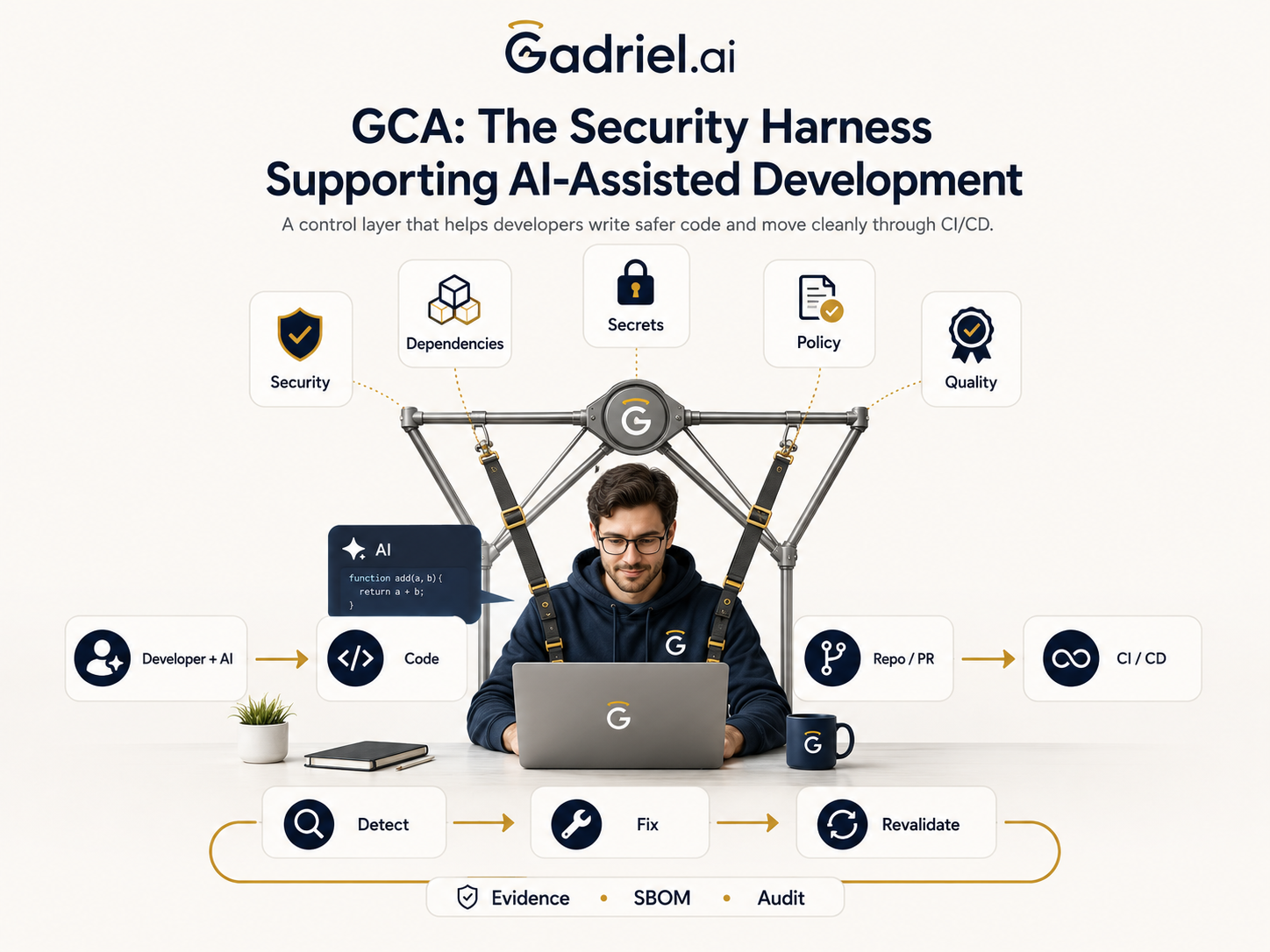
The easiest way to visualize an AI Development and Security Harness is the developer standing inside it.
Above the developer is enterprise development context: Policies. Standards. Architecture. Approved components. Lessons learned.
Around the developer are the controls: Security. Dependencies. Secrets. Infrastructure. Compliance. Quality.
Beside the developer are the AI coding tools.
Ahead is the development path:
Code → Repository → Pull Request → CI/CD → Release
The harness supports the developer throughout that path.
It continuously helps answer one question:
Is what we are creating ready to move forward?
When something is wrong, the harness returns the issue while the developer still has the context to fix it.
When it passes, development continues.
That is the role of an AI Development and Security Harness.
Gadriel Code Assurance Is an AI Development and Security Harness
This is what we are building with Gadriel Code Assurance, GCA.
GCA provides an AI Development and Security Harness for AI-assisted software development.
It works alongside developers and AI coding tools to validate what is being created before issues move downstream.
GCA is designed to help identify security problems, dependency risks, secrets, infrastructure and configuration issues, policy violations, and other development risks while software is still being built.
When GCA finds a problem, the objective is not simply to generate another finding.
The objective is to return the problem into the development workflow while the context still exists, fix it, and validate it again.
As organizations deploy GCA more broadly, the AI Development and Security Harness can also provide a consistent mechanism for bringing enterprise development context, policies, standards, and security controls to developers across repositories and CI/CD environments.
The AI coding tool can change.
The developer can change.
The repository can change.
The enterprise controls remain.
Install the Gadriel AI Development and Security Harness for Free
This is not a future architecture.
Developers can start using Gadriel Code Assurance today for free.
Install the Gadriel AI Development and Security Harness with npm:
npm install -g gadriel
Use GCA alongside your AI-assisted development workflow to begin validating what AI writes before issues move into pull requests, CI/CD, and production software.
Enterprises should not have to choose between the productivity of AI-assisted development and the controls required to build secure enterprise software.
The answer is to bring those controls closer to the developer.
AI Changes How Software Is Written. The Harness Changes How It Is Controlled.
AI will continue to make developers faster.
The question is whether enterprise development systems can keep up.
- Can every developer inherit the knowledge of the organization?
- Can enterprise policy reach the developer before the pull request?
- Can security problems be fixed before context is lost?
- Can enterprises prevent the same mistakes from being repeated?
- Can security scale as quickly as AI-generated software?
- Can developers move faster without giving up control?
That is what an AI Development and Security Harness is designed to accomplish.
Give every developer the accumulated knowledge, guardrails, and security expertise of the enterprise while they work.
Try Gadriel Code Assurance
Put an AI Development and Security Harness around the way your developers build software.
Install GCA for free:
npm install -g gadriel
Gadriel.ai — AI Assurance for Code, Behavior, and Deployment.