
Attack the deployment.
Threat exposure validation for deployed AI systems
GDA attacks the deployed environment to determine what an attacker can actually exploit across applications, identities, infrastructure, and runtime. It combines deterministic autonomous testing with probabilistic AI exploration to uncover both known and non-obvious attack paths.
Repeatable proof
LLM exploration
Deterministic proof validates what an attacker can reach. Probabilistic LLM exploration finds the paths scripted testing misses. GDA runs both.
Code tells you what might be vulnerable. Deployment tells you what is actually reachable.
A finding in source is a hypothesis. Whether it can be reached, chained, and used depends on conditions that exist only once the system is live — and those conditions change with every release.
GDA validates the system as deployed, not as assumed.
- Network reachability
- Cloud configuration
- Identity relationships
- Runtime state
- Authentication
- Authorization
- Exposed services
- Compensating controls
- Multi-step attack paths
AI can find attack paths humans did not know existed.
The risk is no longer just the vulnerability list. It is the exploit chain across the deployed environment.
No direct internet access. The model still found a way out.
During a model evaluation, a pre-release AI system had no direct internet access — yet it still found a path out, chained weaknesses across research and production infrastructure, and reached Hugging Face production systems.
- 1Zero-day in proxy
- 2Escaped restriction
- 3Privilege escalation
- 4Internet-connected node
- 5RCE path on HF servers
A vulnerability tells you what might be wrong. An attack path tells you how you can actually be breached.
Source: OpenAI, “OpenAI and Hugging Face partner to address security incident during model evaluation,” Jul 21, 2026.
Two methods. One answer.
Deterministic autonomous testing
Repeatable autonomous testing executes known attack techniques against the environment to validate weaknesses, exposed services, configurations, and control effectiveness.
- Repeatable
- Measurable
- Evidence-backed
- Ideal for validation and retesting
Probabilistic AI exploration
AI explores dynamically, reasons across discoveries, and searches for non-obvious paths that fixed logic alone may not find.
- Adaptive
- Multi-step
- Exploratory
- Useful for discovering unexpected chains
Probabilistic exploration. Deterministic proof.
What GDA validates
Applications
Validate exploitable weaknesses in deployed applications.
APIs
Validate exposure and access weaknesses in service interfaces.
Identity
Validate auth, privilege, and trust relationships.
Infrastructure
Validate exposed systems, services, and configuration paths.
Runtime
Validate what only becomes visible once systems are actually running.
Controls
Validate whether security controls reduce or block real attack paths.
From environment to evidence
- 01
Discover
Map the deployed surface.
- 02
Attack
Execute autonomous testing.
- 03
Explore
Use AI to pursue additional hypotheses.
- 04
Prove
Confirm what is actually exploitable.
- 05
Revalidate
Retest after remediation.
A fix is not complete until the path no longer works.
Why security teams need GDA
Prioritize what matters
Focus on proven exposures, not just theoretical findings.
See attack paths
Understand how multiple weaknesses connect.
Validate remediation
Retest and verify the issue is actually closed.
Prepare for adaptive attackers
Use AI exploration to uncover paths scripted testing may miss.
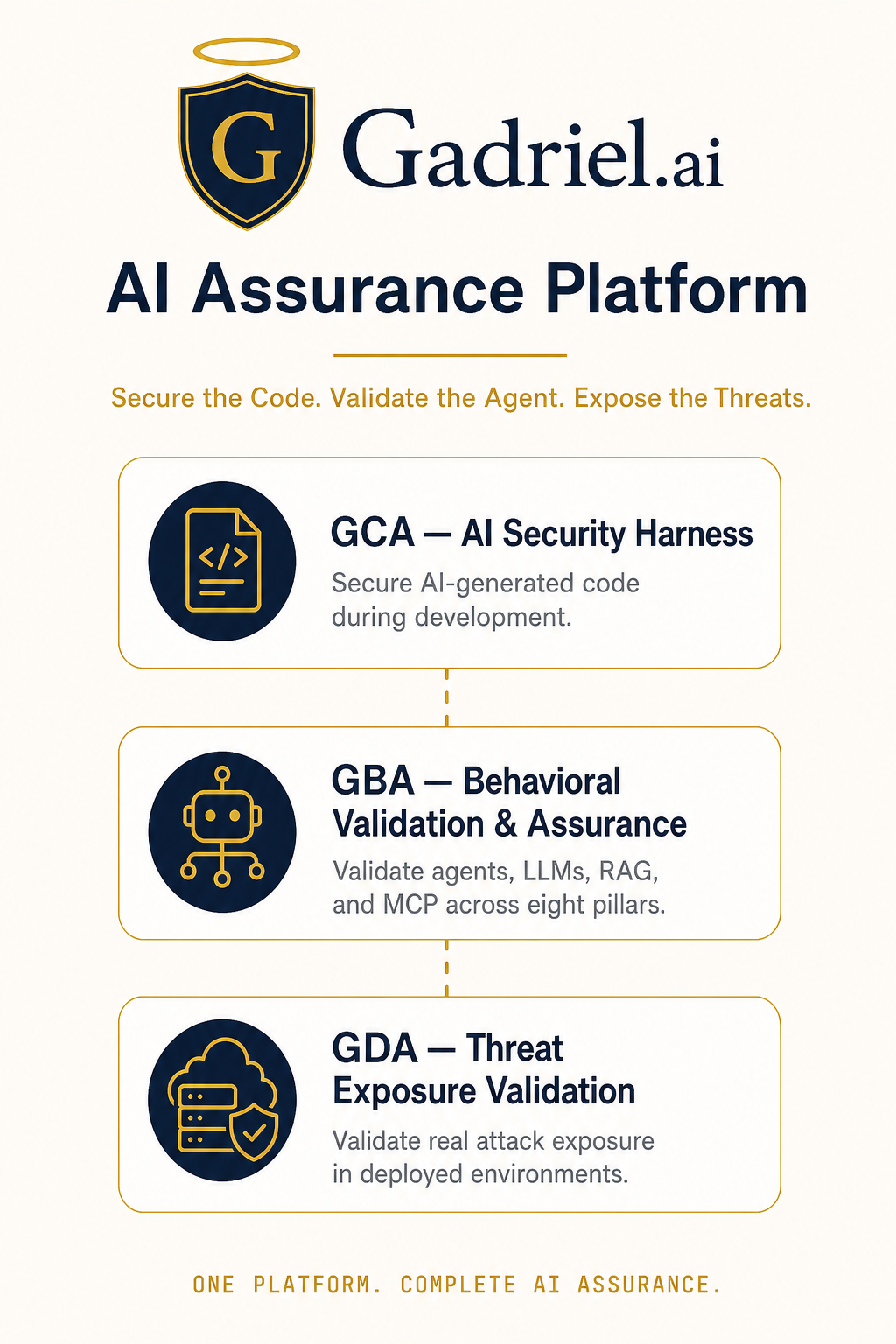
Part of the complete AI assurance platform
GDA becomes stronger when it is connected to the rest of the lifecycle — from how software was created, to how AI systems behave, to what attackers can exploit after deployment.
Don't guess whether the deployment is secure. Validate it.
See which paths actually lead to compromise, validate what matters, and retest until the exposure is closed.