
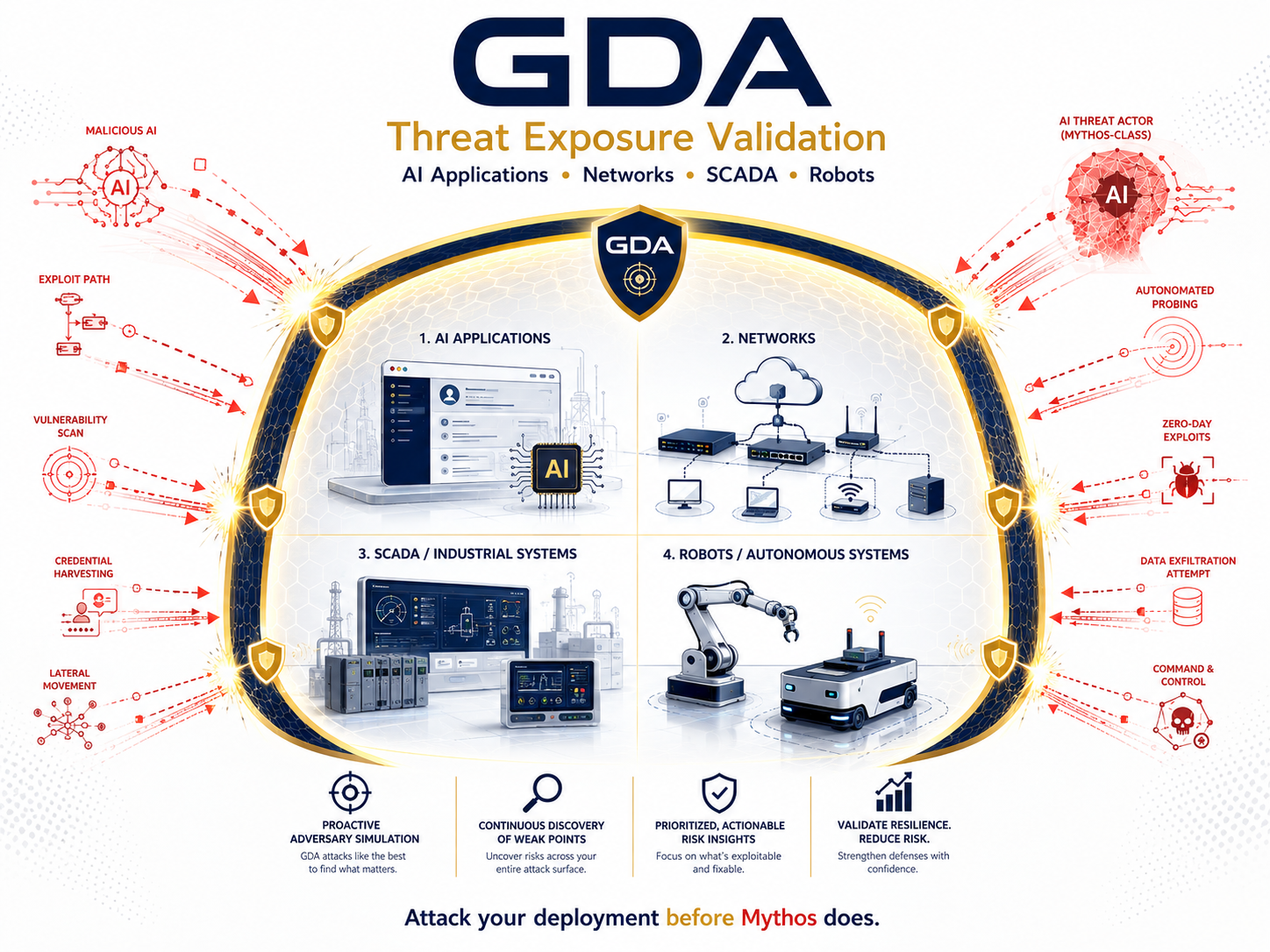
AI is changing both sides of cybersecurity.
Defenders are using AI to move faster. Attackers are too.
That matters because most security programs still assume a slower, more linear threat model. Scan for vulnerabilities. Review findings. Patch over time. Re-test later. That approach was already imperfect. In an era of foundation-model-assisted attacks, it becomes dangerously incomplete.
Attackers are no longer limited to what a single human operator can manually enumerate, chain, and exploit. They can now use AI to probe faster, search broader, correlate weaknesses across systems, and discover attack paths that traditional tools often miss.
That is the problem Gadriel Deployment Assurance is built to solve.
Why deployment assurance matters now
Secure code does not guarantee a secure deployment.
Even well-written software can be exposed by:
- misconfigurations
- weak authentication or authorization
- risky network paths
- exposed services
- exploitable integrations
- brittle runtime environments
- insecure industrial and autonomous system connections
The reality is simple: risk emerges from the full deployed environment, not just from source code.
That is why Gadriel approaches the problem as Threat Exposure Validation.
Instead of only asking, "Are there vulnerabilities?" we ask a more important question:
What can an attacker actually exploit in this deployed environment?
From vulnerability management to threat exposure validation
Traditional security tools are good at producing lists.
They are less good at telling you which issues matter, how those issues connect, and what a capable attacker can actually do with them.
Threat Exposure Validation changes the model.
Gadriel Deployment Assurance continuously validates real-world attack exposure across the environment and identifies the attack paths that matter most. It combines deterministic autonomous testing with LLM-driven exploration to uncover weaknesses across a broad attack surface.
The goal is not more alerts. The goal is to expose the paths an adversary would use before an adversary uses them.
GDA protects more than traditional IT
Modern enterprises do not operate in a single domain.
They now run a mix of:
- AI applications
- enterprise networks
- SCADA and industrial systems
- robots and autonomous systems
These environments increasingly overlap. An exposed API can affect an application. A weak network segment can enable lateral movement. A poorly isolated industrial system can create operational risk. A robot or autonomous device can become a bridge into the physical world.
That is why GDA is designed to validate threat exposure across all of them.
1. AI Applications
AI applications introduce new security and operational risk through agents, model-connected workflows, retrieval pipelines, tool use, and increasingly complex application logic.
GDA helps validate:
- exposed services and application weaknesses
- exploitable integrations
- unsafe deployment patterns
- attack paths into AI-enabled workflows
2. Networks
Networks remain the connective tissue of the enterprise — and often the highway attackers use to expand access.
GDA helps validate:
- exposed network services
- misconfigurations
- segmentation weaknesses
- lateral movement opportunities
- authentication and authorization exposure
3. SCADA and Industrial Systems
Industrial environments are often hard to patch, hard to test, and deeply connected to operational outcomes.
GDA helps validate:
- exposed industrial systems
- insecure connectivity
- exploitable control paths
- weaknesses across industrial infrastructure
4. Robots and Autonomous Systems
As AI moves into physical systems, security failures stop being purely digital.
GDA helps validate:
- exposed robotic and autonomous infrastructure
- insecure communications paths
- weaknesses in connected control environments
- attack exposure that could impact physical operations
What GDA is looking for
Gadriel Deployment Assurance is focused on surfacing what is exploitable and actionable.
That includes:
- exploitable vulnerabilities
- misconfigurations and exposed services
- weak authentication and authorization
- multi-step attack paths
- infrastructure and runtime exposure
- attack chains across heterogeneous environments
In other words, GDA is built to answer the question security leaders actually care about:
Where can an attacker get in, how far can they go, and what should we fix first?
Why this is different
GDA is not just another scanner.
It is designed to behave more like an attacker and less like a reporting engine.
That means:
- deterministic autonomous testing to validate known classes of weakness with consistency
- LLM-driven exploration to uncover less obvious paths and combinations
- prioritized findings focused on exploitable risk
- broad environment coverage across AI applications, networks, SCADA, and robots
This combination matters because the attack surface is no longer narrow, and attackers are no longer predictable.
Attack before Mythos does
We use the term Mythos-class attackers to describe the coming wave of adversaries that use powerful foundation models to automate discovery, accelerate exploitation, and increase the scale of attacks.
Whether the attacker is a sophisticated red team, an organized threat actor, or an emerging AI-driven offensive platform, the implication is the same:
The cost of finding your weaknesses is going down for them. That means the cost of waiting is going up for you.
Security teams need to validate deployed environments before those weaknesses are discovered externally.
That is the role of GDA.
GDA in the broader Gadriel platform
Gadriel is building an AI Assurance Platform across three layers:
- GCA — AI Security Harness during development
- GBA — Behavioral Validation & Assurance before AI systems are trusted
- GDA — Threat Exposure Validation in deployed environments
Together, these cover the core lifecycle:
- secure the code
- validate the agent
- expose the threats
That is the shift security teams need to make.
Not just more scanning. Not just more monitoring. Real assurance across code, behavior, and deployment.
The bottom line
If your environment includes AI applications, enterprise networks, industrial systems, or autonomous machines, you already have a broader and more dynamic attack surface than most security tools were built to handle.
The question is not whether weaknesses exist.
The question is whether you will find them first.
Gadriel Deployment Assurance helps you attack your deployment before Mythos does.
If you want to learn more about Gadriel's AI Assurance Platform, visit gadriel.ai.